365
spaces of the americas
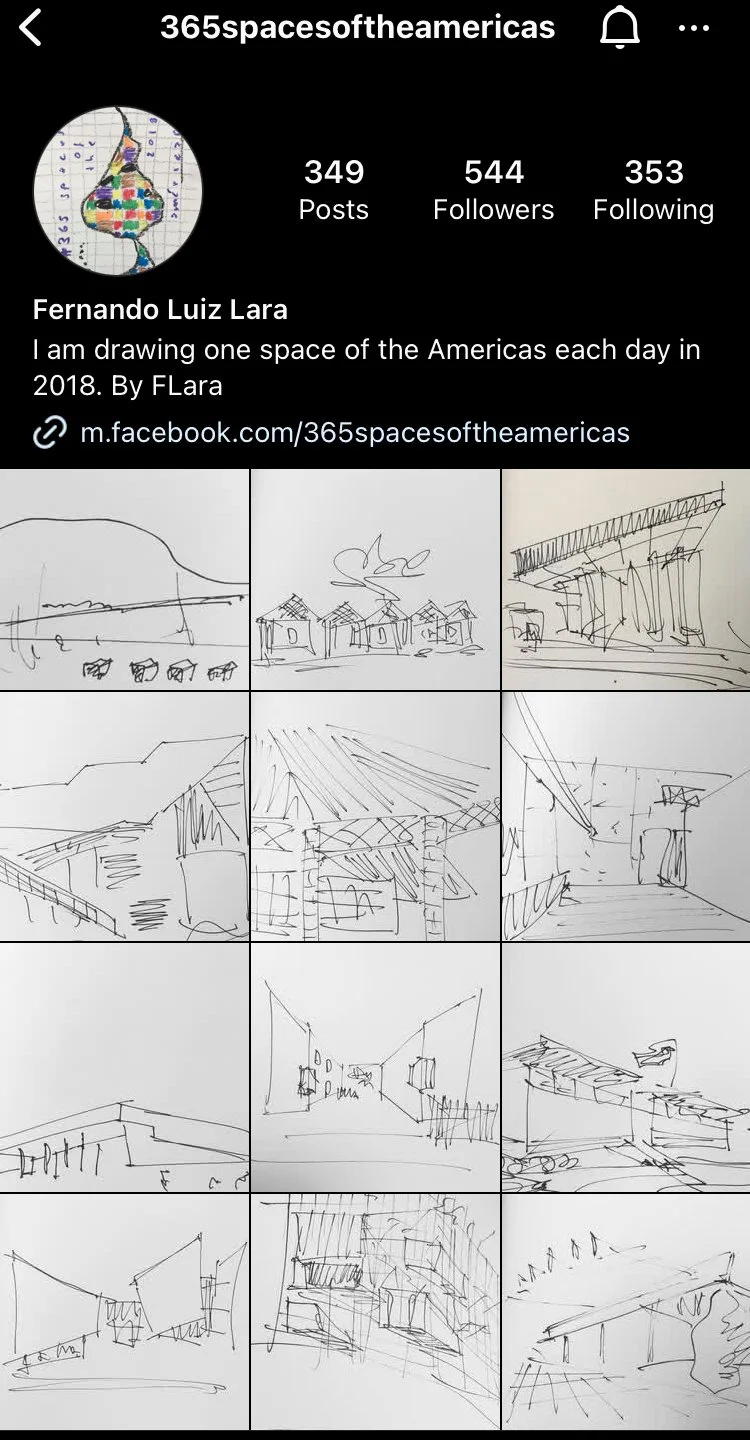
This project was structured around the idea that we don’t know the spatial history of our own continent that well. From January 1st to December 31st, 2018, I drew one sketch a day, highlighting the spatial aspect of important moments in the history of the Americas.
The sketches were posted on Instagram and are still available at:
instagram.com/365spacesoftheamericas
In 2025 I edited a book with all 365 sketches, now available at Ingram Spark and Amazon.
Continuing this project, I am selling original watercolors based on the 365 drawings.
The basic package is a 9x12 watercolor and a copy of the book for 200 USD. Other watercolor sizes are available upon request.
Please select from the list below the day/site that interests you and fill the form to let me know. I should be able to answer the next day about shipping arrangements.
January 1, The Idea, SOLD
January 2, Teotihuacan, Could we understand Teotihuacan as an early form of equal society as proposed by Graeber and Wengrow in ‘The Dawn of Everything’?
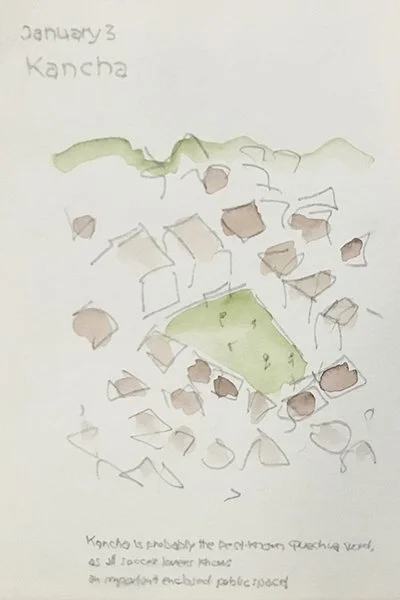
January 3, Kancha, SOLD
January 4, Xingu, The people of Xingu believe that humans were created from wooden logs of the kuarup tree.
January 5, La Venta, The main site of the Olmec civilization (500 BCE-600 CE). The southern part of the island was destroyed to build an oil refinary. What a good summary of our continent it is!
January 6, Mapuche, Mapuche means “people of the earth”, and as our Chilean friends know well, we desperately need to learn from their example.
January 7, Zuni, Zuni comes from the Spanish mispelling Shi’wi, meaning, “the flesh.”
January 8, Carib, SOLD
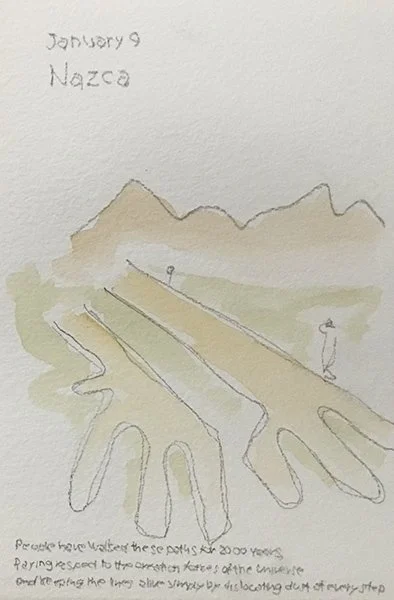
January 9, Nazca, SOLD
January 10, Fig Island, As early as 5000 years ago, the first inhabitants of the Americas built shell rings on the coast of today’s South Carolina.
January 11, Paracas, SOLD
January 12, Tupinambá, The first people to face the Portuguese in Bahia. From the Tupinambá came the first recorded critique of European culture, as registered by Montaigne in the 1570s.
January 13, Potiguara, In the northeast coast of Brazil, the Potiguara resisted for one full century, accepting an alliance with the Portuguese only in 1599.
January 14, Inuit, Around the year 1000 of our era, descendents of the Thule settled in the northern latitudes of our continent. They call themselves Inuit.
January 15, Caral, Considered the first city of the Americas, Caral was built 5000 years ago in the Pacific coast of South America. A complex society based on fishing, Caral shows no trace of warfare. Our first city was pacifist.
January 16, Sambaqui, SOLD
January 17, Poverty Point, 3,000 years ago the inhabitants of the lower Missisippi valley moved 2 million cubic meters of soil to create an artificial mountain along a large meeting plaza.
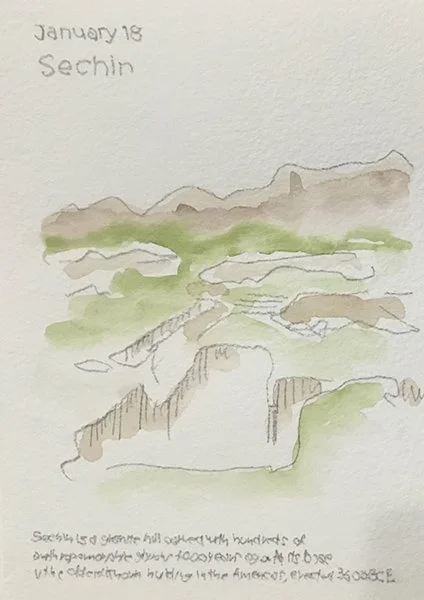
January 18, Sechin, SOLD
January 19, Piraquê-Açu, From the Tupi: Pira means fish and Açu means big; the big fish of the Brazilian Atlantic coast, still inhabited by the Tupi-Guarani people.
January 20, Tolteca, In Nahuatl Toltec means cultured, urbanite, the intellectual roots of Pre-Columbian Mexico.
January 21, Yanomami, I learned from Hanna Limulja that Ya No Mami means “I am not dead.”
January 22, Hohokan, Inhabiting the site of the contemporary city of Phoenix, the Hokokan built irrigation canals and rectangular pit houses.
January 23, Cueva de las manos, At 48 degrees south, where Patagonia meets the Andes, a group stencilled their hands in the walls of a cave, 13,000 years ago.
January 24, Cumbe Mayo, Cumbemayo means narrow river in Quechua, in reality an irrigation canal built 3500 years ago.
January 25, Meadowcroft, Located along the eastern banks of the Ohio river, Meadowcroft show signs of human habitation 19,000 years ago
January 26, Pedra Furada, The rock paintings at Pedra Furada, Piauí, are only 12,000 years old, but charcoal and arrow shards are as old as 48,000 years, challenging the idea that humans came only from the Behring strait (Clovis hypothesis).
January 27, Monte Verde, The occupation of Monte Verde in the south of Chile (41 S) 18,000 years ago is another challenge to the Clovis hypothesis of human occupation solely via Siberia/Alaska.
January 28, San Agustin, In the lush valley of the Magdalena river in equatorial Andes, the people that inhabited San Agustin 2,000 years ago carved giant funerary statues in stone, inscribing their dead for eternity.
January 29, Guarany, One of the few languages to survive the European occution, Guarany is spoken by 7 million people today, mostly in Paraguay.
January 30, Cochiquinas, The Western foot of the Andes where the Amazon river grows has always been a center of equatorial civilization.
January 31, Aymara, The Aymaras believe that llamas brought water to the altiplano, and will return to the form of water springs at the end of time.
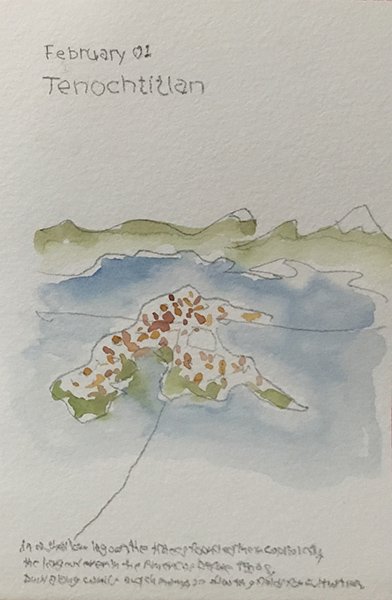
February 01, Tenochtitlan, SOLD
February 02, Coricancha, SOLD
February 03, Tical, Tikal, or Yax Mutal - waterhole - in ancient Maya, was the center of the classic Mayan civilization 1800 years ago.
February 04, Kuhikugu, At the headwaters of the Xingu river in the Brazilian savana, the Kuikuro people built monuments to their gods along the terrain, horizontally.
February 05, Cañar, The great Cañari nation built Ingapirca 4000 years ago.
February 06, Cantona, Cantona was a walled city of the Olmec-Xicalanca, built 1500 years ago.
February 07, Tumembamba 1493-1525, It is buried today under the contemporary city of Cuenca, Equador.
February 08, Corozal, Controlling trade between the Caribbean sea and the rivers Hondo and Nuevo, Corozal was an important Mayan settlement as early as 3,000 years ago.
February 09, Calakmul, In the Mayan lowlands of the Peten valley, Calakmul was the main city of the Kaan (snake) Kingdom, with 50,000 inhabitants around the year 800 CE.
February 10, Machu Pichu, Built as a palace for Pachacuti around the year 1450, Machu Picchu was so well hidden that no European was able to locate and sack the city for 450 years.
February 11, Huanuco Pampa, At three thousand six hundred meters (11,000 ft) above sea level, Huanuco Pampa was a gigantic celebration of the Inka bureaucracy, an architecture designed to convey imperial power.
February 12, Copan, In the year 837 of our era, the ruler of Copan, Uaxaclajuun Ub’aah K’awiil was assasinated, promtping a long period of instability that led to the abandonment of this great city some decades later.
February 13, Joya de Ceren, Around the year 600 CE, a large volcanic explosion covered the city with ashes, freezing Joya de Ceren as a unique window into the American past.
February 14, Tres Zapotes, Founded 3,000 years ago by the Olmec civilization, Tres Zapotes was continuously inhabited for over 20 centuries.
February 15, Cumbaya, The history of the Americas is written in stone.
February 16, Mesa Verde, For over 700 years the ancestral pueblo people inhabited the cliffs that today we call Mesa Verde.
February 17, Chan Chan, In a dry flat land quite close to the ocean, the Chimu people built an intricate network of canals that turned the desert into a fertile valley, with its capital, Chan Chan, the largest adobe city in the Americas.
February 18, Nadzcaan, Close to the sky is the meaning of Nadzca’an in Mayan, a magnificent city unkown to European settlers until recently.
February 19, Angamuco, At the banks of lake Patzcuaro in Michoacan the Puerepecha bulit a large city that housed over 100,000 people 8 to 10 centuries ago.
February 20, Purus, At the border of today’s Brazil and Bolivia, the headwaters of the Purus river, the Amazonian inhabitants inscribed their socio-cosmologies in the earth.
February 21, Sayil, Twenty two centuries ago the Chontal people built the palace of Sayil.
February 22, Guanahatebey, The hunter-gatherers Guanahatebey inhabited the Greater Antilles before being displaced by the agriculturalist Taino.
February 23, El Pilar, Close to 180,000 Mayans inhabited the area of El Pilar (nowadays Belize) in the 10th century of our era.
February 24, Cahoquia, SOLD
February 25, Uxmal, A magnificent complex in the Puuc style, Uxmal shows a level of craft and detail unmatched even by other amazing Mayan cities.
February 26, Xochicalco, Xochicalco—house of flowers—in Nahuatl, was built by Olmeca-Xicalanca that moved west from the Campeche region.
February 27, Chaco, Chaco Canyon was the largest settlement of the ancient pueblo civilization around the year 1100 of our era.
February 28, Tastil, In the highlands of Atacama desert, the city of Tastil thrived until invaded by the Inka around the year 1500 of our era.
March 01, L’Anse aux Meadows, Ten centuries ago the Vikings tried to colonize the northeastern shores of America.
March 02, La Isabella, Founded by Columbus in 1493, La Isabella was the first city bulit by Europeans on the Caribbean islands.
March 03, Terra Nova de Bacalao, In 1476, 16 years before Columbus, the Portuguese navigator João Vaz Cortereal arrived in the island of Terranova, at the mouth of the Saint Lawrence river.
March 04, Santo Domingo, Founded on one side of the Ozama river in 1496 and connected to the other side in 1502, Santo Domingo is the oldest European city in the Americas still inhabited.
March 05, Marajó, The marajoara people inhabited this large island at the mouth of the Amazon river for 2000 years, until being almost completely exterminated by the European arrival in the 1600s.
March 06, Península de Paria, Columbus reached South America on his third voyage, landing in Paria in August of 1498.
March 07, Cabo Santo Agostinho, The spanish navigator Vicente Gomez landed in Cabo Santo Agostinho in january of 1500, four months before the Portuguese Alvarez Cabral who ended up claiming the land for his king.
March 08, Bahia de Todos os Santos, In 1501 the Portuguese had trouble choosing a saint for this large bay, called it Todos os Santos - all saints.
March 09, Las Tortugas, Directly north of La Habana and west of the Florida Keys are the three Tortuga Islands, a heaven for pirates.
March 10, Santa Cruz Cabrália, Named after the portuguese admiral Alvares Cabral and the holy cross of the European fanatics, is the land of the Pataxo who have resisted the Cruz for 523 years and counting.
March 11, Chakanputun, This chiefdom in the southern Yucatan peninsula was also called Can Pech, a name that survives in the present Mexican state of Campeche.
March 12, Caloosahatchee, The Calusa people had altered the Caloosahatchee river for centuries, buliding canals in the swamps to facilitate movement and trade.
March 13, San Juan, In the smallest but very strategic island of Puerto Rico, the Spanish built their city in 1521 and called it San Juan.
March 14, Guanabara, The bay where the Portuguese founded the city of São Sebastião do Rio de Janeiro was called Guaná-Pará (breast of the ocean) by its original Tupinambá inhabitants.
March 15, Catemaco, Founded by the Olmecs, Catemaco means “burned houses” in Nahuatl, perhaps due to a nearby volcano. Today the city is famous for its sorcerers.
March 16, Mississipi, The Obijawa words Michi Sepe mean the gathering of all waters.
March 17, Rio de la Plata, The silver (plata) was not at the large river formed by the Paraná and the Uruguay but 500 miles inland, in Potosi.
March 18, La Habana, The local Taíno leader was called Habaguanex, in the tradition of the Louisianas, Charlestons, and Bolivias we named after.
March 19, Santa Maria del Buen Ayre, Real de Nuestra Señora Santa María del Buen Ayre was founded once, destroyed by the local Charruas, and founded again 50 years later.
March 20, Iximche, Iximche was the main city of the Kaqchiquel, who initially allied with the Spanish invaders to raid other groups, but eventually grew tired of their demands and abandoned the place, burned by the desolate Castillanos.
March 21, Piaçabuçu, From large (gauss) palm tree (piaçava) in Tupi, the delta of the São Francisco river.
March 22, Santa Maria de Belém do Pará, In 1616 the Portuguese founded a city at the delta of the Amazon to control the river that looks like an ocean - Pa’ra in Tupi-Guarani.
March 23, Afuá, On the other side of the Marajó island the city of Afuá was built on stilts and is lucky to have no automobile access to this day.
March 24, Patagônia, From the vantage point of theiAndes, the kechua speaking people named the eastern lands Pata Ko - hilly lands.
March 25, Santa Maria del Darián, Founded by the Spanish in 1510, the city was destroyed by the Guna resistance and rediscovered only in the 21st century.
March 26, Cananéia, Settled in 1535, Cananéia sits right at the Tordesillhas line, the papal division of the planet between Spainish and Portuguese kingdoms.
March 27, Atacames, Africans who were able to escape their brutalized slavery created a settlement that is today’s Atacames.
March 28, Cajamarca, Here Atahualpa was kidnapped by Pizarro and assassinated despite paying the ransom.
March 29, Punta Quemada, In 1525 Quitian warriors handed a heafty defeat to Pizarro’s expedition at Punta Quemada (burned by the Spanish in their retreat).
March 30, Sacsayhuaman, The citatel of Sacsayhuaman, north of Cuzco, had its walls dismantled to build Spanish houses and temples in the main Inka city after 1532.
March 31, Metztitlan, Metztitlan was the center of the Otomi state, a group not conquered by the Aztecs at the time of the European invasion. Otomitl in Nahuatl means the ones who walk with arrows.
April 01, Millions died by bacterias and viruses drawn here to scale.
April 02, Cartagena, After the defeat of the local Karibs and the destruction of their village, the Spanish took control of the bay in 1533, making Cartagena a fundamental stop for all the riches of Mexico and Peru on their way to La Habana and Sevilla.
April 03, La Habana, The land of Habaguanex became another important knot in the thread that connected Mexico, Peru, Cuba and Sevilla.
April 04, Panama, The Cueva and Cocle people called this place Panama after the abundance of fish.
April 05, San Juan, The old Ciudad de Puerto Rico was the third permanent settlement built by the Spanish invasors in the Americas, after Santo Domingo and Panama Viejo.
April 06, Santiago de Cuba, Built at the Southern end of the island, Santiago was the capital of the Spanish colony of Cuba from 1522 to 1589.
April 07, Santa Marta, Displacing the Tairona people, the Spanish built the city of Santa Marta.
April 08, Caracas, The Teques and the Caracas fought the Spanish invadors for a whole decade, until disease wiped them out and Diego de Lozada named his city after a catholic saint -Santiago - and the displaced inhabitants - Caracas.
April 09, San Agustin, The oldest European settlement in what is now the USA, Saint Agustine was founded by the Spanish in 1565.
April 10, Veracruz, When Hernan Cortez arrived at the Americas main land in 1519 he named the place after the cross he fanatically belived in.
April 11, Lima, Named after an oracle - Lima means “the one who speaks” in Quechua - the site was renamed Ciudad de los Reyes by the Spanish invadors in 1535.
April 12, Potosi, The exploitation of silver at the Serro Rico de Potosi forced thousands of local Aymara and Quechua people into a system of indentured servitude called mi’ta.
April 13, Guadalajara, The fierce resistance of the Caxcan, Portecuex and Zacateco groups forced the Spanish to abandon the old village of Guadalajara and create a new one in 1542.
April 14, São Paulo, Jesuit priests founded a school - Colegio de Piratininga - in 1554, originating the city that they would later call São Paulo.
April 15, Salvador, To protect the Bay of All Saints, the Portuguese built a fort at the peninsula and named the settlement after ‘the savior” - Salvador.
April 16, Philadelphia, SOLD
April 17, New Amsterdam, Named Manhattan by the native Lenape people, the island was renamed New Amsterdam by the Dutch invadors in 1625.
April 18, Santiago de Chile, In 1541 Pedro de Valdivia entered the fertile vally of the Mapocho river, displaced the residents and founded the city of Santiago de la Nueva Extremadura.
April 19, Santa Fé de Bogotá, The Muiscas called this side of the hill Bacatá, a place invaded by Gonzalo de Quezada and renamed Santa Fe de Bogota.
April 20, Buenos Aires, Buenos Aires was founded twice in the lands of the Tehuelche. The first invasion of 1541 was rebuked. The second invasion of 1580 gave the Spanish a fortification to control the river to acess Potosi - Rio de la Plata.
April 21, São Luis do Maranhão, The french claimed the Tupinambá island of Upaon-Açu and named if after their King Luis.
April 22, Campeche, Can Pech was a Mayan city renamed Campeche by Francisco de Montejo in 1540.
April 23, Boston, Massachusett was the name of the group that lived in the Shawmut peninsula before John Winthrop.
April 24, Antigua Guatemala, Founded in Iximche in 1524, it was moved to Almolonha in 1527 and to the valley of Panchoy in 1541, where it still sits.
April 25, Belém, Named initially as Feliz Lusitania (happy Portuguese), Belem sits over the Mairi lands.
April 26, Recife, In 1630 the Dutch took control of Olinda and, abandoning the hill, decided to occupy the sand banks (arrecifes) of the Capibaribe and Beberibe rivers.
April 27, Tampico, The “place of the dogs“, in the Huasteca language, Tampico sits at the mouth of the Panuco river.
April 28, New Orleans, Called Balbancha or “place of many tongues.” by the natives, New Orleans still holds the character of a cosmopolitan city.
April 29, Puebla, Allegedly founded on “empty” territory, the plan of Puebla is as much renaissance as it is a copy of the plan of Cholula, its indigenous neighbor.
April 30, Quebec, Stadacona was the Iroquois settlement where Quebec sits today.
May 01, Atlantic, Over 12 million people were enslaved and transported across the Atlantic to sustain the European invasion.
May 02, First African slaves brought by Juan de Cordova, Juan de Cordoba, originally from Seville, was the first merchant to get royal authorization to trade people between Africa and the Americas.
May 03, Agriculture, One of the main justifications for European land grabbing was the absence of “agriculture” defined as the removal of all life for a single species to grow.
May 04, Industry, Indigenous bodies, from here or from Africa, have always been the main power of all industries in the Americas.
May 05, Transportation, African bodies were the transportation system of the Americas.
May 06, Domestic work, Indigenous female bodies, from here or from Africa, did all domestic work for the Europeans and their descendants
May 07, Salvador, From 1530 to 1830, Salvador recieved 1,214,036 enslaved Africans.
May 08, Cartagena, The Sinu lived in a village caleld Calamarí which was abandoned before the arrival of conquistador Pedro de Heredia.
May 09, Veracruz, When Hernan Cortez arrived in the American mainland in 1519 he named the place after the cross he fanatically belived in.
May 10, Sapelo Island 1526, Occupied by Spanish missionaries since the 16th century, Sapelo Island is now home to the Gullah Geechee, descendants of the first Africans enslaved in the Carolinas.
May 11, Serra da Barriga/Palmares 1605, For almost a century (1605-1694) the free black territory of Palmares resisted both Dutch and Portuguese attacks in the Brazilian Northeast.
May 12, San Lorenzo de los Negros, Led by Gaspar Yanga, San Lorenzo de los Negros first fought the Spanish in 1609 then negotiated territorial autonomy in 1618.
May 13, Santa Ana de Coro, In 1795 the Santa Ana de Coro rebellion, led by Jose Chirino, attempted to end slavery and white supremacy.
May 14, Curaçao, Also in 1795 the Curaçao rebellion, led by Tul’a, attempted to end slavery and white supremacy.
May 15, Granada 1795, And still in 1795 the Granada rebellion, led by land owner Julien Fedon, attempted to become independent from British rule.
May 16, Engenho Santana 1789, The Engenho Santana rebellion was not exactly for abolition of slavery but for regulating work conditions: one day of rest, no whip, better food.
May 17, Stono River 1739, The largest slave rebellion in North America was the Stono River revolt of 1739.
May 18, New York 1741, In 1741 Manhattan had the second largest enslaved population in British North America, and a series of arsons were bundled together as slave revolt.
May 19, Prosser plantation 1800, The Prosser plantation revolt of 1800 was led by Gabriel in the young state of Virginia.
May 20, Coromantee 1760(1605), The Akans, also known as Coromantees, led several revolts in the American colonies: Antigua, New York, Virgin Islands and Jamaica.
May 21, Salvador 1835, The Malês, being literate in arabic, plotted a revolt that paralized the city of Salvador in 1835.
May 22, Triunvirato 1843, Carlota Lucumi was a yoruba woman who led the revolt in the Triunvirato plantation, in the island of Cuba, in 1843.
May 23, Haiti 1804, The first and only succesful slave revolt in the Americas was fought from 1791 to 1804 and resulted in Haiti declared as a black republic.
May 24, Charleston 1822, Denmark Vesey planned a revolt in Charleston to coincide with the bastille day of July 14th 1822, but was betrayed a few weeks before and executed on July 2nd.
May 25, Virginia 1831, Net Turner led the Virginia revolt of 1831, the deadliest in US history.
May 26, Demenara 1823, Ten thuousand enslaved people rebelled in Demenara, Guiana, in 1823.
May 27, Aponte 1812, Led by Jose Antonio Aponte, cubans in Camagüey and Bayano attempted a revolt to end slavery.
May 28, Haussa, Before the big revolt of 1835, the Malês, also known as Hausa, had rebelled in 1807.
May 29, Guamacaro 1829, The revolt of the enslaved in Guamacaro, 1825, is special because the land owners were from the young republic of the USA.
May 30, Vallano, In Vallano (or Bayano) Panama there were so many revolts they called it a war.
May 31, Jamaica 1728, Jamaican Maroons rebelled against the British in 1728 and held the rebellion for a whole decade.
June 01, Monclova 1607, Monclova, just south of the Rio Grande’s big band, would later be the capital of Coahuila y Tejas.
June 02, Santa Fe 1608, SOLD.
June 03, Bucaramanga 1622, The Guane people inhabited the place nowadays known as Santander, before the city of Bucaramanga was founded.
June 04, Barranquilla 1629, The Kamash lived in the cliffs (barrancas) where the Spanish founded Baranquilla de Camacho.
June 05, Paranaguá 1633, Paranaguá, or great round sea in Tupi, was settled by the Portuguese in the 1640s.
June 06, Luque 1635, The lands by the Paraguay river were given to Miguel Antón de Luque in 1635.
June 07, Sorocaba 1661, The Tupiniquins called that river Sorok (rippled) and the Portuguese named their city Sorocaba.
June 08, San Francisco 1766, The town of Yerba Buena was founded in 1766 by Spanish settlers, later renamed San Francisco.
June 09, Intanhaém, Plate of rock in Tupi is the meaning of Intanhaém.
June 10, Santarém, Five hundred miles upriver from the Amazon Delta the Portuguese created a fortification and named it Santarem after a city in their homeland.
June 11, Iguapé, Y (water), Kua (delta) and Pe (at) in Tupi makes At the River Delta the meaning of Iguape, occupied by the Portuguese in the 1530s.
June 12, Quilmes, Southwest of Buenos Aires is the city of Quilmes, names after the Kilmes tribe of the northern plains.
June 13, La Candelária de Medellin 1675, Founded as “el poblado” in 1616, it was renamed Nuestra Senhora de la candelaria de Medellin in 1675.
June 14, El Paso, Mansos and Sumas lived on the banks of the Rio Bravo before the spanish named the river and the crossing sand banks El Paso del Norte.
June 15, Rosario, The Cachaqui people were already being forced to live in “reduciones” when the settlement of Pago de los Arroyos was renamed as Rosario.
June 16, Knoxville, The Cherokee names their river Tennessee way before the Anglo settlers arrived, controled the river and built a city named after Washignton’s War secretary Henry Knox.
June 17, Matanzas, Matanzas, Cuba, is named after the occasion in 1510 in which 30 Spanish soldiers drowned after forcing local Taino fisherman to transport them accross the bay.
June 18, New Haven, The Quinnipiack lived in the area occupied by the puritans who justified their invasion of 1638 as a Christian Utopia.
June 19, Baltimore, The Irish named this port city Baile an Tí Mhóir: big house town.
June 20, Tallahassee 1695, Tallahassee means “old fields” in Apalachee language, and that was precisely the area claimed by Hernando de Soto’s expedition of 1539.
June 21, Talca, San Agustin de Talca was created in 1742 as part of a 250 year war of attrition between the Spanish and the Mapuche.
June 22, Ponce, Named after Ponce de Leon to commemorate 200 years of the Spanish conquer in 1692.
June 23, Quebec, Kebec, in the Algonquin language means “where the river narrows.”
June 24, Port Royal, Nova Scotia, Originally named Acadia, Port Royal was the first French settlement in North America.
June 25, Plymouth, The first Puritan separatists arrived in 1620 making a treaty with the Wampanoag that would soon be broken.
June 26, Salvaterra, The Purépecha, and before them the Chichimeca inhabited the valley of Huatzindeo, where Franciscan friars renamed Salvaterra a century later.
June 27, Concepción, Known as La Frontera until the 1870s because south of the Bio Bio river the teritory was controlled by the Mapuche.
June 28, Sisoguichi, The hill of Taharumara, named after its original inhabitants, hosted the Jesuits who named the site Sisoquichic - place of arrows.
June 29, Juticalpa, The silver mines of Guayape were served by the agricultural town of Juticalpa - in Nahuatl snail home.
June 30, Santa Rosa, The Poeceo people inhabited the lands by the Zaruma gold mines where the Spanish created Santa Rosa in the 16th century.
July 01, Vila Rica, The Itacolomi rock (stone boy in Tupi) helped the bandeirantes remember the creek where they found gold in 1695.
July 02, Glaura, Hungry miners blinded by the gold rush needed food that was cultivated in Glaura.
July 03, Mariana, Less than 10 miles separate the intellectual and libertine Ouro Preto from the pious Mariana.
July 04, Sertões de Taubaté, Hundreds of miles north of Taubaté the paulistas tried to claim the mines as their domain.
July 05, Congonhas, Congoi in Tupi means “the one who feeds”, another city created to support hungry miners.
July 06, São José del Rey, A rocky hill separated São José from Sáo João, both cities dedicated to El Rey.
July 07, Sabará, Sabarabuçu means large shinny rock in Tupi, the name given to this hill full of metals.
July 08, São João Del Rey, Arraial Novo do Rio das Mortes - new village on death river was the name given to this place between 1701 and 1713.
July 09, Santa Bárbara, The creek rich with gold was named after Santa Barbara because the Portuguese arrived there on her day of December 4th, 1704.
July 10, Serro, Cold Hill - Serro do Frio was the name given to the place in 1702.
July 11, Roças Novas, Roças Novas means new cultivation, another city built to feed the miners.
July 12, São Brás, Suasuy means deer creek in Tupi, the name of the water added to an Armenian saint from the 4th century CE.
July 13, São Gonçalo do Rio das Pedras, Visions of a saint under a guava tree justify naming this town after this Portuguese priest from the 12th century cannonized in 1551
July 14, Morro Vermelho, Rich in iron ore, the earth of Minas Gerais has different tones of red from oxidation, thus the name Red Hill.
July 15, Vila Boa de Goiás, The Tupi called themselves gwaya - people that are my equal, my fellow.
July 16, Barão de Cocais, Morro Grande - big hill was the name of this town before the Brazilian government renamed it after a local landowner.
July 17, Bento Rodrigues (destroyed by mud in 5 Nov 2015), The small town of Bento Rodrigues, right downriver from a large Vale iron ore mine, was destroyed by a mudslide in Nov 5th, 2015.
July 18, Acurí, Acuru y means pebble creek in Tupi.
July 19, Dom Joaquim, Rio do Peixe - fish river - was the original name of this place.
July 20, São Gotardo, Gotardo de Hildemshein, born in the 10th century, names this place in Minas Gerais, 700 years and 6500 of miles away.
July 21, Monsenhor Horta, Most mining cities were named after original Tupi words, catholic saints or local prists such as Horta, Joaquim or Isidro.
July 22, Amarantina, (Fe3+)2O(SO4)2(H2O)4 ·3H2O is the chemical compost commonly called Amarantina - usually indicates gold formations nearby
July 23, Nossa Sra dos Córregos, Our Lady of the Creeks was probably invoked to protect miners who worked with their legs deep in the water.
July 24, Monsenhor Isidro, Another small mining village named after a local bishop.
July 25, Diamantina, Diamond Town, the name explains the reason the Portuguese exterminated the Malalis and Copoxós who lived there earlier.
July 26, Alto Maranhão, Arraial do Redondo - round village - was the 18th century name of this town.
July 27, São Felipe, Felipe Neri, italian clergy of the 16th century, named this mining village.
July 28, Camargos, SOLD.
July 29, Cachoeira do Campo, A waterfall on the Itabirito river named this town.
July 30, Sopa, The original name of the land of Iviturí, renamed Sopa by the diamond miners of the late 18th century.
July 31, Santa Rita Durão, Inficionado (infected) was the name of this village, renamed after a poet born there in 1722.
August 01, Zacatecas, The original inhabitants retained the name of this region where 200,000 tons of silver were extracted since the Spanish invasion.
August 02, Pachuca, Patiachiucan means “narrow place” in Nahuatl, another rich silver mining place in operation since the Aztecs ruled the region.
August 03, Guanajuato, Guamare or “children of the wind” were the name of the original inhabitants of Cuanaxhuato - the hill of frogs in Nahuatl.
August 04, San Luis Potosi, San Luis de Mezquitique was the name of this mining town before being renamed for its southern (Bolivian) counterpart.
August 05, Carabaya, The Aymara called this mountain range Kallawaya, meaning place of the healers.
August 06, Copiapó, The Diaguita people were the last of 10,000 years of occupation of those lush lands that the Spanish explored for silver in the 18th century.
August 07, Chachapoias, The Chachapoyas lived at the headwaters of the Marañon-Amazon river, at the eastern flanks of the Andes
August 08, Antofagasta, Town of the great salt lake in the indigenous Cacan language.
August 09, Popayan, Po Pa Yan means village of reed roofs, the name of the original settlement of the Sonso culture.
August 10, Tegucigalpa, Taguz Galpa means silver hill in Nahuatl, another city founded by resource exploitation.
August 11, Tehuantepec, Jaguar Mountain was the original name of this Zapotec town that named the Isthmus.
August 12, Sultepec, The land is called Tolomostas but the Spanish renamed it San Antonio de las Invernadas.
August 13, Hualgayoc, City in the Plains is the Ayamara meaning of Hualgayoc.
August 14, Tlapujahua, Inhabited by the Mazahuas, Tlalpujahua means spongy
August 15, Zaruma, Meaning corn (sara) head (uma) in Quechua, Zaruma was built by the Cañari people around the year 500 CE.
August 16, Zumpango, Tzompanco, Nahuatl for Row of Hair is the name of this settlement at the margins of a lake of the same name, occupied by different ethnic groups for over 3000 years.
August 17, Oruro, The Uro Uro people lived in the area rich in silver, renamed Oruro by the Spanish conquerors.
August 18, Cerro de Pasco, At 14,000 ft above sea level, Cerro de Pasco became known as “men-eating-mountain” after the Spanish forced the indigenous to work the mines.
August 19, Valdivia, The southernmost city of Spanish America, Valdivia is home to the Monte Verde fossils that challenge the Clovis theory of human occupation in the Americas.
August 20, Huencavelica, Spanish miners tried to call the site Vila Rica de Oropesa but native workers insisted in calling is Huancavelica, from Quechua Wankawillka.
August 21, San Antonio del Nuevo Mundo, In Uyuni, Bolivia, sits the now abandoned mining town of San Antonio del Nuevo Mundo.
August 22, Castrovirreyna, Named Chuqlluqucha or Coyca Palca in Quechua, the town of Castrovirreyna gave the Spanish enough silver to pave an entire street
August 23, Nóvita, The first Spanish capital of the Choco province, Nóvita was created around a gold mine worked by enslaved Africans
August 24, Parral, Silver mines were found in the land of the Conchos, today’s Parral, Chihuahua.
August 25, Colima, Coliman means “place of the ancestors”in Nahuatl, a city by the Pacific ocean in the vicinity of a volcano of the same name: Coliman - the grandfather.
August 26, Valdivia, On May 22, 1960, the most powerful earthquake in recorded history with a magnitude of 9.5 struck Valdivia, killing 5,000 people.
August 27, Lota, SOLD
August 28, Batopilas, The Raramuri people called that site Bachotigori, place of the enclosed waters.
August 29, Zimapan, Cimatl + Pan means the place of the pulque roots, in Nathatl.
August 30, Texco, Tlachco means the place of the ball game, another mining town in Central Mexico.
August 31, Real del Monte, The Real del Monte strike of 1766 is considered be the first real labor strike in North American history.
September 01, Boston Harbor 1773, American colonists dumped 342 chests of tea in the water to protest taxation.
September 02, Concord 1775, The first shots of the American revolutionary war happened in Concord, Massachusetts, April 19, 1775.
September 03, Saratoga 1777, The battle of Saratoga, NY, in October of 1777 gave the American revolutionary a much needed morale boost.
September 04, Tupac Amaru 1780, José Gabriel Condorcanqui – known as Túpac Amaru II, led a revolt against the Spanish in Peru, 1780.
September 05, Oruro 1781, Two parallel rebelions, one by locals of Spanish descent (creolos) and another by Andean people shoked the mining town of Oruro in 1781.
September 06, Haiti 1791, What would be the first succesfull rebellion of Black People in the Americas started in Haiti in 1791.
September 07, Alfaiates 1798, The revolt of the tailors (Alfaiates in Portuguese) in Salvador da Bahia, August 1798, attempted to free Brazil from Portugal.
September 08, San Lorenzo 1813, The first battle of the Argentinian independence war was fought in San Lorenzo, February of 1813.
September 09, Buenos Aires 1806, British forces managed to invade Buenos Aires in 1806 but were forced to retreat after street fights killed half their contingent.
September 10, Chuquisaca 1809, In May of 1809 the people of Chuquisaca (today Sucre, Bolivia) rebelled for self government.
September 11, Dolores 1810, On September 16, 1810, priest Miguel Hidalgo rang his church bell and called his people to rise against Spain.
September 12, Asencio 1811, In February of 1811 the people at the eastern banks of the Uruguay river (nowadays Uruguay) rallied in support of Buenos Aires’ independence and against Spain.
September 13, Cucuta 1813, Simon Bolivar’s vitory in Cucuta, February of 1813, gave the Gran Colombia independence movement the momentum it needed.
September 14, Chacabuco, After leading the independence war in Argentina, José de San Martin crossed the Andes to support the Chilean independence, beating the Spanish in Chacabuco, 1817.
September 15, Maipu, San Martin and O’Higgins joined forces against the Spanish and defeated them in Maipu, April 5, 1817.
September 16, Tacna 1811, Tacna was the first city in Peru to rebell against the Spanish in June of 1811.
September 17, Cartagena 1812, The Cartagena Manifesto, by Simon Bolivar, was written in that city on December 15, 1812.
September 18, Apatzingan, In the city dedicated to Apahtzï - God of Death - the Mexican revolutionary constitution was signed on October 22, 1814.
September 19, Boyacá 1819, The independece of Nueva Granada / Gran Colombia, was sealed when the revolutionary army led by Bolivar won the battle of Boyaca in 1819.
September 20, Callao, The conquest of Callao in 1826 marked the end of Spanish rule in South America.
September 21, Pichincha, The battle of Pichincha, at the foot of the volcano of the same name, established the independence of the province of Quito.
September 22, Maracaibo, Spanish and revolutionary forces fought at Lake Maracaibo on July 24, 1823, with another major victory for Bolivar’s movement.
September 23, Guayaquil, SOLD
September 24, Ayacucho, Callao was the last stronghold of Spanish Royalists in Peru, but the war was decided 2 years before, in Ayacucho.
September 25, Soriano, Cuba was fighting for independence since the Ten Years War of 1868-78, with Palma de Soriano in the south as one of the revolutionary centers.
September 26, Campo Maracanã, Maracanã is a bird that would become famous for other battles, this one won by the Argentinians in 1811.
September 27, Tampico, Mexicans and Yankees fought together in 1835 against Antonio Santa Anna.
September 28, Curupaity, In September of 1866 the Paraguayans held their positions in Curupaity, against superior forces of Argentina, Brazil and Uruguay.
September 29, Everywhere in Brazil 2018
September 30, Campichuelo, On 19 December 1810 the forces led by Manuel Belgrano conquered the Spanish garrison at Campichuelo on the Parana river.
October 01, Washington DC, The Piscataway lived there before the Maryland colonists and the 1783 rebellion in Philadelphia that pushed the revolutionary government in search of a new capital.
October 02, Louisiana Purchase, Following the Haitian revolution, Napoleon decided to sell his North American colonies, giving the young USA control of the conection between the Gulf of Mexico and the Great Lakes.
October 03, Jeffersonian grid, Land had to be abstracted into numbers and detached from those who lived there in order fit better into the capitalism system.
October 04, Fighting for slavery 1835, Anglo settlers in Tejas fought against Mexico in 1835 to be able to keep slavery in place.
October 05, Fighting for slavery again 1861, Anglo settlers in Texas, now joined with USA, fought again to keep slavery in place in 1861.
October 06, Saint Louis, The encounter of 2 mighty rivers have attracted people for thousands of years.
October 07, Chicago, The marshland called shikaakwa connected the Great Lakes to the Gulf of Mexico.
October 08, Land Grabbing 1835, They already owned much of the Tejas land in 1835 but fought to keep slavery in place and their lands profitable.
October 09, Land Grabbing 1848, Half of the Mexican territory was taken by the USA army in 1848.
October 10, Land Grabbing 1865, Brazil and Argentina grabbed half of Paraguayan territory in 1865.
October 11, Land Grabbing 1876, Chile invaded Bolivia and Peru in 1879, gaining access to saltpeter mines to make more gunpowder to make more wars.
October 12, Land Grabbing 1903, The young Brazilian republic took over the lands north of Acre River, previously controlled by Bolivia.
October 13, Amerindian Holocaust, On this day we remember that 90% of the Amerindian population died in the 16th century.
October 14, Orthogonal grid is a tool for land grabbing, No caption needed here: Orthogonal grid is a tool for land grabbing.
October 15, New Orleans, Sold due to the Haitian revolution, purchased by Thomas Jefferson , it has always been about white supremacy.
October 16, Rio de Janeiro 1808, Fleeing Napoleon, the whole Portuguese court moved to Rio, making it the capital of an European Empire.
October 17, Guano, Chile, Bolivia and Peru fought for islands where they explored Guano in the 1860s.
October 18, Esclavitud abolida en Mexico 1829, No caption needed here unless you have trouble understanding this as the cause of Texas independent movement a few years after.
October 19, Buenos Aires 1813, Argentina extends the vote to mestizos and indios, outlaws torture, slavery and the Inquisition.
October 20, Jenipapo 1823, Portugal tried to keep the Amazon separate from independent Brazil but lost a battle at Jenipapo, Piaui, 13 March 1823.
October 21, Homestead Act, 160 million acres (10 % of contemporary USA) was given free to 1.6 million white settlers as a result of the Homestead Act.
October 22, Nuestra Senhora de la Porciuncula, Anglo settlers start moving into Mexican California.
October 23, Lei de Terras 1850, Brazilian empire legalized private land ownership in 1850, but never surveyed the land to determine who owned what.
October 24, Oaxaca 1847, Benito Juarez, a Zapotec, is elected governor of Oaxaca.
October 25, Jose Marti 1895, José Marti was killed fighting the Spanish at the Battle of Dos Rios, Cuba, 19 May 1895.
October 26, Rio de Janeiro 1888, Regent princess Isabel signs the law outlawing slavery - the last country in the Americas to do so.
October 27, Canudos 1897, The Brazilian government massacred a colony of destitute people who followed prophet Antonio Conselheiro in the backlands of Bahia.
October 28, Chaputepelc, France invaded Mexico and tried to re-colonize it, abandoning the idea after fierce resistance led by Benito Juarez.
October 29, Chicago 1870s, The city of Chicago was growing exponentially fast when a fire burned 25% of its structures in October of 1871.
October 30, Quinta da Boa Vista, Elias Antonio Lopez, slave trader, built the palace that would become the official residence of Brazilian emperors.
October 31, Chicago 1890, Bold architects and empowered speculators created the elevator and new structures to build skyscrappers.
November 01, San Juan 1915, Antoni Nechodoma broughtFrank Lloyd Wright’s praire style to Puerto Rico in 1915.
November 02, Estridentópolis 1925, German Cueto designed a city of the future (1975) based on the ideas of Estridentismo, a literary group led by Manuel Maples Arce.
November 03, San Angel 1931, SOLD
November 04, Buenos Aires 1936, Corina Kavanaugh comissions a residential skyscrapper - tallest buildling in Latin America - for herself and her elite friends.
November 05, Montevideo 1936, Julio Vilamajó designs the Engineering School building for Universidad de la Republica, Montevideo.
November 06, Mar del Plata 1942, While an architect in the north designed a house over a waterfall, Amancio Williams designed one over a creek, with a much more modern plan.
November 07, Rio de Janeiro 1946, Affonso Reidy and Carmen Portinho built Pedregulho, an avantgarde housing complex in Rio de Janeiro.
November 08, New York 1947, A workshop of ten architects united in NYC to design the headquarters of the United Nations choose Oscar Niemeyer’s scheme among all others.
November 09, Ciudad de México 1947, In Ciudad de Mexico, architect Mario Pani designed the Multifamiliar Miguel Aleman.
November 10, Pampulha 1943, Oscar Niemeyer changed the history of modern archietcture with a few lines.
November 11, Atlântida 1952, Eladio Dieste decided to be an architect in order to be a good catholic, and thus built the most amazing church.
November 12, Ciudad de Mexico 1953, Felix Candella explored thin vaults to build all kinds of programs in Mexico.
November 13, Caracas 1955, Fruto Vivas explores the parabolic vault to maximize the grand view of Caracas.
November 14, São Paulo 1957, SOLD
November 15, Montevideo 1962, Carlos Bayardo designs the most elegant buillding for the dead.
November 16, Ciudad de México 1964, Pedro Ramirez Vasquez builds a monument to Mexican indigenous cultures.
November 17, Guatemala 1971, Efrain Recinos designed a brutalist / mayan theater for Guatemala.
November 18, Salvador, João Filgueiras Lima places 12 concrete petals in a circle to create an amazing chapel.
November 19, Ouro Branco 1977, Éolo Maia wraps a 18th century ruin with a metal envelope to rebuild a chapel.
November 20, São Paulo 1985, Lina Bo Bardi understood São Paulo when she moved to Bahia, bdesigning her masterpiece - SESC Pompeia - 2 decades later.
November 21, São Paulo 1988, There was no collection but Mendes da Rocha invented a museum of sculpture our of thin topography.
November 22, Brasilia 1991, Paulo Mendes da Rocha chooses Bucci and Puntoni as his successors on the Sevillha Pavillion competition.
November 23, Buenos Aires 1993, Pablo Beitia created the perfect spaces for Xul Solar watercolors.
November 24, Asunción, Solano Benitez built the most poetic homage to a father.
November 25, Rosario, SOLD
November 26, Inhotim, SOLD
November 27, El Cabuyal, Very young architects change the word by building a school with their own hands.
November 28, Cantinho do Céu SOLD
November 29, Concepcion, Formal geometry, when well done, can stir emotions too.
November 30, Medellin, The most simple materials, composed with a small rotation, generates enough complexity to awe.
December 01, Quito, Where are the real architecture of the Americas? Quito government complex.
December 02, Vancouver, Patkau architects builds winter shelter by bending plywood.
December 03, Inhotim, It makes sense to name this building after Roberto Burle Marx for it does blend with the landscape.
December 04, El Alto, Freddy Mamani pushes the limits of our definition of architecture.
December 05, Ciudad de Mexico, The old and the new should always shine together.
December 06, Asunción, Joseto Cubilla opens the house to the breeze and the rain.
December 07, Quito, SOLD
December 08, Inhotim, Brazil is explained in the trail between Claudia Andujar and Miguel Rio Branco.
December 09, Rosario, Rafael Iglesia makes concrete float.
December 10, Jalisco, Derek Dellekamp builds the most poetic ring around the woods.
December 11, Talca, The future of design education is already happening in Talca.
December 12, Santiago, Imagine building a 3-story office and leaving with the garbage/debris in a couple of bags.
December 13, Aldeia Xucuru, The Ema landing of Cacique Chicão challenge my spatial knowledge.
December 14, São Paulo, Marcos Boldarini proves that low income housing can and should look the best.
December 15, Caracas, Espacios de Paz trusts that architecture can make a difference in the most difficult contexts.
December 16, Austin, Alejandro Araveña’s student housing is the best building in town.
December 17, Queretaro, Poncho Garduño believes that architecture can deliver a better word.
December 18, Asuncion, Aqua Alta makes a difference with very little.
December 19, Rio de Janeiro, Carla Juaçaba builds a manifesto with scaffolding.
December 20, Rio de Janeiro, Thiago Bernardes stitches two buildings with a delicate canopy.
December 21, Santiago, Smiljan Radic highlights the strength of rocks.
December 22, Cuernavaca, Frida Escobedo builds for Siqueros.
December 23, San Pedro, Sometimes the market is the community core.
December 24, Ciudad Acuña, Tatiana Bilbao redesigns the simplest house.
December 25, Cretaús, SOLD
December 26, São Paulo, Andrade and Moretin redefine the architectural components.
December 27, Jarinú, A palm tree in Tupi.
December 28, Grano de Oro, Kapaklajui indigenous center by Entre Nos in Costa Rica.
December 29, Paxixil, Axel Paredes turns a library into an indigenous force.
December 30, Ti Kay La, Small house in creole - Haiti.
December 31, Chinati, Donald Judd formalist utopia in the desert.